
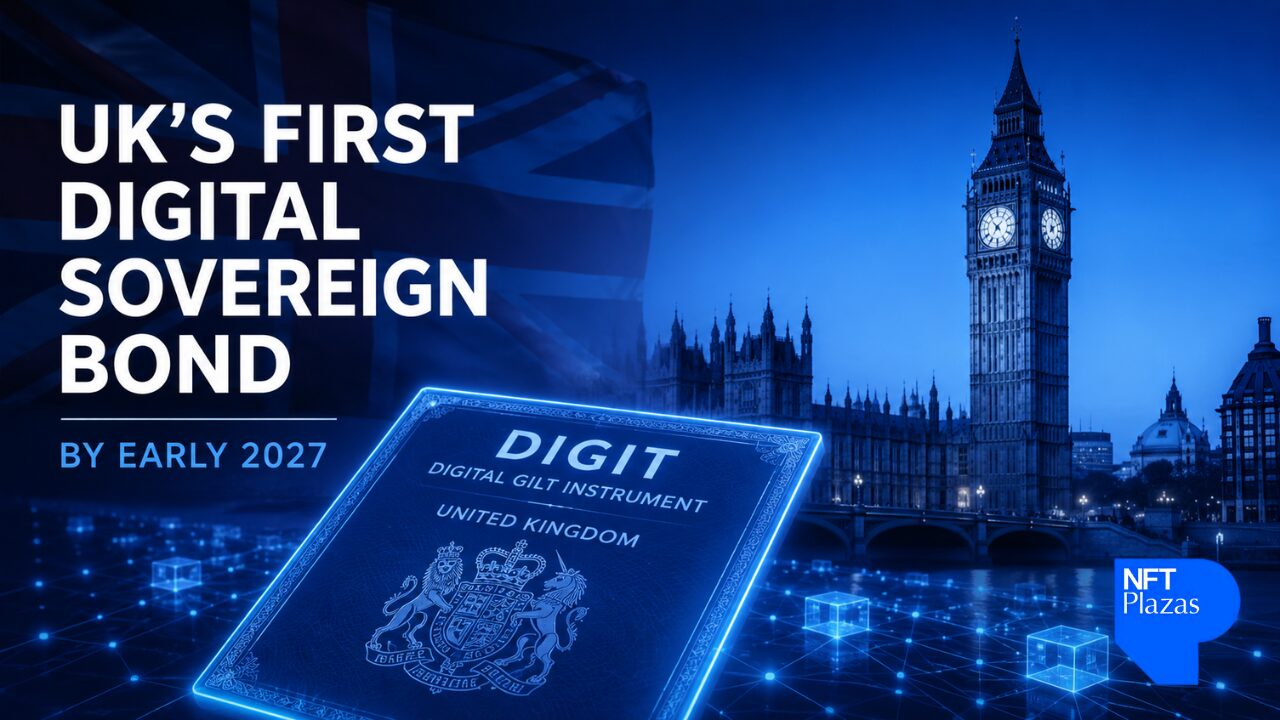
The United Kingdom is preparing to become the first G7 nation to issue a digital sovereign bond, marking a significant milestone in the adoption of blockchain technology within traditional finance. Chancellor Rachel Reeves announced that the inaugural Digital Gilt Instrument (DIGIT) is expected to launch by early 2027, positioning the UK as an early leader in the tokenization of government debt.
Speaking during her annual Mansion House address in London, Reeves said the issuance forms part of the government’s broader strategy to modernize financial markets and reinforce the UK’s role as a global digital finance hub. Officials also confirmed that additional digital gilt issuances are planned following the inaugural sale.
A Digital Gilt on Blockchain
DIGIT will be a sterling-denominated UK government bond issued on HSBC’s Orion digital asset platform using distributed ledger technology (DLT). While the bond itself is a conventional gilt backed by the UK Treasury, blockchain will be used to manage issuance and settlement, replacing parts of the traditional market infrastructure.
The issuance will take place within the Digital Securities Sandbox, a joint initiative by the Bank of England and the Financial Conduct Authority (FCA) that allows regulated firms to test blockchain-based financial infrastructure.
The Treasury first announced the DIGIT initiative in 2024 to assess whether DLT could improve efficiency in sovereign debt markets. HSBC was selected earlier this year to deliver the platform after a competitive procurement process.
According to HSBC, Orion has facilitated more than $3.5 billion in digitally native bond issuances across sovereign, supranational, central bank, financial institution, and corporate issuers, making it one of the world’s most established blockchain bond platforms.
Improving Market Efficiency
The UK government views DIGIT as an infrastructure upgrade rather than a new form of government borrowing.
Officials believe blockchain technology can shorten settlement times, reduce reconciliation between financial institutions, lower operating costs, and improve transparency throughout the bond lifecycle. These efficiencies could streamline processes that continue to rely on legacy systems in many global bond markets.
The Treasury has confirmed that the first digital gilt will sit outside the government’s conventional financing program, allowing authorities to evaluate the technology before considering wider adoption.
Key details—including the bond’s size, maturity, coupon rate, investor eligibility, and settlement asset—have not yet been disclosed.
Bank of England Supports the Initiative
The project also received backing from the Bank of England.
Governor Andrew Bailey said the central bank will work toward making DIGIT eligible as collateral in its market operations. If approved, banks could use the digital gilt in central bank funding facilities and tokenized repurchase (repo) transactions, integrating blockchain-based government securities into existing liquidity markets.
Making the bond eligible as collateral would give it practical utility beyond the initial issuance and could encourage greater institutional participation in tokenized financial assets.

UK Plans First G7 Digital Sovereign Bond by Early 2027
A Broader Digital Finance Push
The announcement aligns with the UK’s wider effort to become a leader in digital finance. Alongside the digital gilt initiative, the government continues advancing policies covering tokenized assets, stablecoins, and digital market infrastructure.
Rather than focusing on cryptocurrencies, policymakers are increasingly exploring how blockchain can improve the efficiency of traditional financial products while operating within established regulatory frameworks.
Industry participants welcomed the announcement as another sign that tokenization is moving closer to mainstream capital markets.
Faye Clark, Head of Manager Research at XPS, said a digital sovereign bond could accelerate institutional adoption of digital assets, but cautioned that investor education and supporting infrastructure—including secure custody, digital wallets, and trading capabilities—must continue to mature.
She added that while the inaugural issuance is unlikely to transform investment portfolios immediately, it sends a strong signal that governments are becoming more comfortable using blockchain technology in regulated financial markets.
Setting a G7 Benchmark
Several jurisdictions, including Hong Kong, have already issued blockchain-based government bonds. However, the UK’s initiative would make it the first G7 economy to launch a digital sovereign bond, a milestone that could influence other advanced economies exploring similar projects.
If successful, DIGIT could demonstrate how blockchain can improve the issuance and management of government debt without changing the underlying characteristics of sovereign bonds. With future issuances already planned, the UK is positioning tokenized government securities as part of the next generation of global capital markets.